
Fire Fighting System
Dry Pipe System
Category: Fire Fighting System
Dry Pipe Sprinkler System — Fire Protection for Cold Storage, Parking Structures & Unheated Facilities
PT Totalfire Indonesia designs and installs dry pipe sprinkler systems for facilities where standing water in the piping would freeze, corrode, or cause accidental discharge — including refrigerated cold storage, unheated warehouses, open parking structures, outdoor canopies, and loading docks across Indonesia.
All our dry pipe systems are designed in full compliance with NFPA 13 (Standard for the Installation of Sprinkler Systems), supported by our ISO 9001:2015 and ISO 45001:2018 certifications.
What Is a Dry Pipe Sprinkler System?
A dry pipe sprinkler system is an automatic fire sprinkler system in which the supply piping is filled with pressurized air or nitrogen — not water — under normal standby conditions. Water is held back by a dry pipe valve located in a heated space, and only flows into the system after a sprinkler head opens in response to heat from a fire.
This design solves a fundamental problem: in spaces where ambient temperature falls below 4°C (40°F), a standard wet pipe system would risk freezing — rendering it inoperable precisely when it is needed most, or causing pipe rupture from ice expansion. Per NFPA 13, wet pipe systems shall not be installed where temperatures may fall below 4°C without freeze protection measures. The dry pipe system eliminates this constraint entirely.
Beyond freeze protection, dry pipe systems are also the correct choice for any area where unintended water discharge from a damaged or corroded wet pipe would cause serious secondary damage to products, equipment, or stored inventory.
How a Dry Pipe Sprinkler System Works
- Normal Standby — The supply piping is charged with compressed air or nitrogen at a pressure lower than the water supply pressure. The differential pressure keeps the dry pipe valve closed, preventing water from entering the system
- Fire Detection — Heat from a fire causes the fusible element or glass bulb in an individual closed sprinkler head to activate, opening that specific head
- Air Pressure Drop — Once the sprinkler opens, pressurized air or nitrogen vents out through that open head, causing system pressure to drop
- Dry Pipe Valve Opens — As air pressure falls, the pressure differential across the dry pipe valve shifts, allowing the valve to trip and water to enter the piping system
- Water Delivery — Water travels through the now-filling piping and discharges from the open sprinkler head(s). Per NFPA 13, water must reach the hydraulically most remote sprinkler within 60 seconds of sprinkler activation
- Alarm Activation — A water flow alarm activates simultaneously, alerting building occupants and the monitoring station
- Reset — After the fire is extinguished and the system inspected, the air or nitrogen supply is restored, the dry pipe valve is reset, and the system returns to standby
Important: Each sprinkler head in a dry pipe system operates independently based on its individual thermal rating — only heads directly exposed to sufficient heat will open. This minimizes water damage to unaffected areas of the facility.
Where Are Dry Pipe Systems Required?
Dry pipe systems are the correct fire protection choice wherever standing water in supply piping is not feasible or desirable. Common applications in Indonesia include:
Refrigerated Cold Storage & Freezer Warehouses
Cold storage facilities operating at sub-zero temperatures are the primary application for dry pipe systems in tropical climates like Indonesia’s. A wet pipe system would freeze solid in a -20°C blast freezer environment. Dry pipe systems — with the dry pipe valve located in an adjacent heated valve room — reliably protect these facilities while keeping the cold chain intact.
Unheated Warehouses & Industrial Buildings
Large warehouses, logistics centers, and industrial buildings with open roofs or minimal heating may experience localized temperature drops in specific zones, particularly near loading dock doors and exterior walls. Dry pipe protection for these zones prevents freeze-related failures while wet pipe covers the conditioned interior spaces.
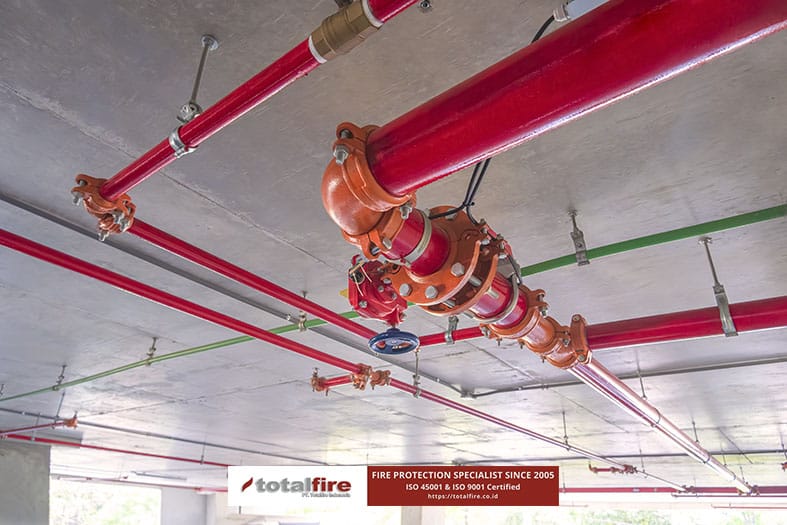
Open Parking Garages & Structures
Multi-level parking structures, podium car parks, and basement parking garages exposed to outdoor air temperature fluctuations are standard dry pipe applications. Open-sided parking structures in particular are subject to wind chill and temperature variation that make wet pipe systems unreliable in certain zones.
Outdoor Canopies & Covered Loading Areas
Loading docks, fuel station canopies, and outdoor covered walkways attached to temperature-controlled buildings often require dry pipe protection for the exposed portions, with wet pipe covering the interior structure.
Water-Sensitive Storage Areas
Facilities storing goods that would be catastrophically damaged by any unintended water discharge — such as archival storage, paper and document warehouses, certain electronic component warehouses, and textile storage — may specify dry pipe systems to minimize the risk of accidental leakage or pipe failure causing water damage even in the absence of a fire.
Corrosive Environments
In facilities where high humidity, chemical vapors, or salt-laden air would accelerate internal pipe corrosion in a water-filled wet pipe system, dry pipe systems (particularly those charged with nitrogen) reduce internal corrosion rates by limiting oxygen exposure inside the piping.
Dry Pipe System vs. Wet Pipe System — Key Differences
| Feature | Dry Pipe System | Wet Pipe System |
|---|---|---|
| Pipe contents (standby) | Pressurized air or nitrogen | Water at all times |
| Activation speed | Slight delay (60-second NFPA max) | Immediate water discharge |
| Freeze protection | ✅ Inherent — no water in pipes | ❌ Requires heating or antifreeze |
| Accidental discharge risk | Lower (air vents before water flows) | Higher (water discharges immediately on head failure) |
| System complexity | Higher — dry pipe valve, air supply, accelerators | Lower — simpler design and installation |
| Maintenance requirements | Higher — annual trip test, air system checks | Lower — fewer components to maintain |
| Pipe sizing | Larger diameter required to meet 60-second delivery | Standard sizing |
| Best suited for | Cold storage, unheated spaces, outdoor structures | Occupied buildings, offices, hotels, hospitals |
| NFPA standard | NFPA 13 | NFPA 13 |
If your facility is fully conditioned and does not face freeze risk, a Wet Pipe System is typically the simpler and more cost-effective solution. Our engineers will recommend the right system type for your specific application.
Dry Pipe System vs. Pre-Action System
Both dry pipe and pre-action systems keep supply piping free of water under normal conditions, but they differ in how water is admitted to the system:
| Feature | Dry Pipe System | Pre-Action System |
|---|---|---|
| Water admission trigger | Sprinkler head opens (air pressure drop) | Separate detection system activates pre-action valve |
| Double interlock available | ❌ No | ✅ Yes — requires both detection AND sprinkler activation |
| Accidental discharge protection | Moderate | Highest — two independent events required |
| Best for | Freeze-prone spaces, parking structures | Data centers, museums, archival storage, server rooms |
For critical environments where even a single accidental water discharge would be catastrophic — such as data centers and server rooms — a pre-action system or gaseous suppression system is typically the more appropriate choice. See our Gaseous Fire Suppression System page for those applications.
Key Components of a Dry Pipe Sprinkler System
- Dry Pipe Valve — The central control valve that holds back water supply pressure using differential pressure from the air-charged system side; trips when system air pressure drops to a set threshold
- Air or Nitrogen Supply — A dedicated air compressor or nitrogen supply maintains system pressure continuously; nitrogen is preferred in corrosion-sensitive applications
- Accelerator / Exhauster (Optional) — Devices that speed up valve tripping and air venting to help meet the 60-second water delivery requirement in larger systems
- Closed Sprinkler Heads — Individual heat-activated heads with fusible links or glass bulbs rated to specific temperature thresholds; each operates independently
- Low-Point Drains — Required throughout the system to remove condensate that accumulates in the piping, preventing corrosion and frozen plugs
- Alarm Check Valve & Water Flow Alarm — Activates a local and/or remote alarm when water begins flowing in the system
- Supervisory Pressure Switches — Monitor air pressure continuously and trigger a supervisory alarm if pressure drops below the set point, indicating a potential system fault
Our Dry Pipe System EPC Process
PT Totalfire Indonesia delivers dry pipe system projects on a full Engineering, Procurement & Construction (EPC) basis:
- Site Survey & Temperature Assessment — We identify freeze-risk zones, ambient temperature ranges, and facility layout to determine dry pipe zones versus wet pipe zones
- System Design & Hydraulic Calculation — Full NFPA 13-compliant hydraulic calculations, pipe sizing (accounting for larger diameters required by dry pipe), sprinkler selection, and air supply sizing to meet the 60-second water delivery requirement
- Equipment Procurement — Dry pipe valves, air compressors or nitrogen supply, accelerators, supervisory switches, sprinkler heads, and all associated fittings sourced from certified manufacturers
- Installation & Pipe Works — Pipe fabrication, installation, low-point drain configuration, and valve room setup by our certified installation team
- Commissioning & Trip Test — Full air pressure testing, dry pipe valve trip test, water delivery timing verification, and alarm function testing with complete commissioning documentation
- Ongoing Maintenance — Annual trip testing, air system inspection, low-point drain flushing, and sprinkler head inspection per NFPA 25 requirements
For ongoing system care, visit our Service & Maintenance page.
Industries We Serve with Dry Pipe Systems
- Cold Chain & Logistics — Refrigerated warehouses, blast freezers, and cold storage distribution centers
- Industrial Manufacturing — Unheated production halls, outdoor covered storage, and corrosive-environment process buildings
- Commercial Property — Open parking structures, podium car parks, and basement parking facilities
- Food & Beverage — Cold storage rooms, freezer tunnels, and blast chilling areas in food processing plants
- Retail & Logistics — Large-format distribution centers with unheated loading dock areas
- Oil & Gas — Outdoor process buildings, equipment shelters, and unheated utility structures at remote facilities
Related Fire Protection Systems
Dry pipe systems are frequently combined with other fire protection systems as part of an integrated facility strategy. Explore our complete range:
- Wet Pipe System — The most common automatic sprinkler solution for conditioned, occupied spaces
- Sprinkler System — Overview of our full automatic sprinkler system capabilities
- Water Spray System — Fixed directional water spray for equipment protection and cooling
- Foam System — Foam suppression for flammable liquid hazards in hangars, tank farms, and fuel storage
- Fire Hydrant System — Manual suppression for large-scale industrial and facility fires
- Gaseous Fire Suppression System — Clean agent suppression for data centers, server rooms, and enclosed equipment areas
Frequently Asked Questions — Dry Pipe Sprinkler Systems
Why would a dry pipe system be needed in Indonesia's tropical climate?
While Indonesia’s outdoor climate is tropical, many industrial facilities create their own low-temperature environments regardless of ambient conditions. Refrigerated cold storage, blast freezers, and freezer tunnels operating at -20°C to -30°C are common in food processing, pharmaceuticals, and cold chain logistics — and all require dry pipe protection for the frozen zones. Additionally, open parking structures, outdoor canopies, and unheated loading dock areas can experience significant temperature variation that makes wet pipe systems unreliable in those specific zones.
What is the maximum water delivery time allowed by NFPA 13 for a dry pipe system?
NFPA 13 requires that water reach the hydraulically most remote sprinkler within 60 seconds of that sprinkler’s activation. This time limit drives several design decisions in dry pipe systems — including pipe sizing (larger diameters to allow faster air evacuation), the potential use of accelerators to speed valve tripping, and the maximum allowable system volume. PT Totalfire Indonesia’s engineering calculations verify compliance with this requirement during the design phase.
What is the difference between a dry pipe system and a pre-action system?
Both systems keep supply piping free of water in standby, but they differ in what triggers water admission. In a dry pipe system, water enters automatically when a sprinkler head opens and air pressure drops — a single event. In a pre-action system, a separate fire detection system must first activate a pre-action valve before water enters the piping. A double-interlock pre-action system requires both detection and a sprinkler head opening — making it the highest level of accidental discharge protection. Pre-action systems are preferred for data centers and archival facilities; dry pipe systems for freeze-protection applications.
Can a dry pipe system be combined with a wet pipe system in the same building?
Yes, and this is common practice. A facility may use a standard wet pipe system throughout its conditioned occupied spaces and a dry pipe system specifically in cold storage rooms, loading docks, or outdoor areas. Both systems connect to the same water supply but operate independently with their own control valves. PT Totalfire Indonesia designs hybrid wet/dry systems as part of our comprehensive facility fire protection engineering.
What maintenance does a dry pipe system require?
Per NFPA 25 (Standard for the Inspection, Testing, and Maintenance of Water-Based Fire Protection Systems), dry pipe systems require: annual dry pipe valve trip test, quarterly air pressure inspections, semi-annual low-point drain flushing (to remove condensate), annual sprinkler head inspection, and periodic internal pipe inspection for corrosion. Dry pipe systems have higher maintenance requirements than wet pipe systems due to the additional components. PT Totalfire Indonesia offers scheduled maintenance contracts covering all NFPA 25 requirements. Contact us to discuss a maintenance agreement.
Is nitrogen better than compressed air for a dry pipe system?
Nitrogen is increasingly preferred over compressed air in dry pipe systems because it significantly reduces internal pipe corrosion. Compressed air contains oxygen and moisture, which — combined with the water that periodically contacts interior pipe surfaces — accelerates microbiologically influenced corrosion (MIC) and oxygen-related corrosion. Nitrogen, being an inert dry gas, greatly reduces this risk and extends the service life of the piping system. PT Totalfire Indonesia can specify nitrogen-based supervisory systems for projects where corrosion management is a priority.
PT. Totalfire Indonesia
PT. Totalfire Indonesia, established in May 2005, is a trusted fire protection system contractor in Jakarta, Indonesia. As a fire protection specialist with ISO 45001 and ISO 9001 certification, we provide engineering, installation, and maintenance services for fire protection systems across commercial and industrial projects, ensuring compliance with NFPA and SNI standards.
Market Range
Industrial Building
Power Plant
Mining Company
Oil and Gas Company
Telecommunication Company
Commercial Building
Residential Building
Contact Us
Ruko Prominence Alam Sutera, Blok 38E No.49
Jl Jalur Sutera, Panunggangan Timur, Pinang
Tangerang Selatan, Banten - Indonesia 15325