
Fire Fighting System
Fire Hydrant System
Category: Fire Fighting System
Fire Hydrant System Contractor in Indonesia — Design, Installation & Maintenance
PT Totalfire Indonesia designs and installs fire hydrant systems for industrial facilities, commercial buildings, warehouses, high-rise developments, power plants, and oil & gas infrastructure across Indonesia. A properly engineered fire hydrant system is the backbone of any facility’s manual fire suppression capability — providing the high-volume water delivery that automatic sprinkler systems are not designed to match in large-scale fire events.
When properly designed and installed, a fire hydrant system can serve a facility for 70 to 100 years — making it one of the most durable and cost-effective long-term investments in fire safety infrastructure. All our fire hydrant systems comply with NFPA 14 (Standard for the Installation of Standpipe and Hose Systems), SNI 03-1745-2000, and applicable local fire authority requirements, backed by our ISO 9001:2015 and ISO 45001:2018 certifications.
What Is a Fire Hydrant System?
A fire hydrant system is a fixed, manual fire suppression infrastructure consisting of a dedicated water supply, a high-pressure fire pump set, a distribution piping network, and hydrant outlets — box hydrants (indoor) and pillar hydrants (outdoor) — strategically located throughout a facility to give trained fire response personnel immediate access to high-volume pressurized water at any point in the building or site.
Unlike automatic sprinkler systems that activate independently without human intervention, fire hydrant systems are manual systems — they require trained operators to connect hoses, control nozzles, and direct water onto the fire. This makes them the tool of choice for large-scale fire suppression where the volume and reach of water required exceeds what any automatic system can provide. Fire brigades, facility emergency response teams, and the municipal fire department all depend on a properly functioning hydrant system to fight major fires effectively.
Water remains the primary fire suppression agent worldwide — universally available, cost-effective, highly effective at absorbing heat, and capable of being delivered in virtually unlimited quantities through a properly engineered hydrant system.
Types of Fire Hydrant Systems
Indoor Hydrant System (Box Hydrant / Hose Cabinet)
Installed inside buildings on each floor, indoor hydrant boxes contain fire hoses, nozzles, and hose reels connected to the building’s pressurized standpipe. Located in corridors, stairwells, and fire compartment boundaries, they allow building occupants and emergency personnel to engage a fire from inside the structure. Indonesian regulations and NFPA 14 classify indoor standpipe systems into three classes based on hose size and intended operator:
- Class I — 2½-inch (65mm) hose connections for use by trained fire department personnel and fire brigades only
- Class II — 1½-inch (40mm) hose stations with lightweight hose for use by building occupants with minimal training
- Class III — Combined Class I and Class II outlets at each location, providing flexibility for both trained and untrained responders
Outdoor Hydrant System (Pillar Hydrant)
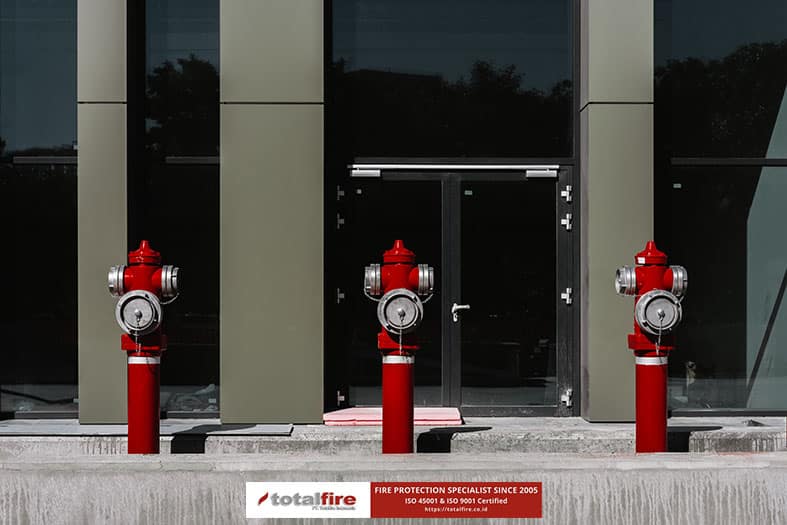
Pillar hydrants are installed outside buildings at intervals throughout a facility’s site perimeter and access roads, providing hose connections for fire department trucks and facility fire brigades fighting fires from outside the structure. Pillar hydrants are available in two configurations:
- Wet Barrel Hydrant — The barrel is permanently filled with pressurized water; each outlet has its own individual valve. Faster to deploy but requires the barrel to remain under pressure at all times
- Dry Barrel Hydrant — The barrel is normally empty; a main valve at the base of the hydrant below ground opens to admit water when the hydrant is operated. Provides protection against accidental discharge and is the standard configuration for most industrial and commercial facilities in Indonesia
Siamese Connection (Fire Department Connection)
A Siamese connection is a ground-level inlet — typically located near the main site access — that allows fire department pumping trucks to supplement the building’s water supply by pumping directly into the standpipe or sprinkler system. This is a critical safety redundancy: if the facility’s internal water supply or pump fails during a major fire, the fire department can maintain system pressure from their own pumping apparatus.
Key Components of a Fire Hydrant System
| Component | Function |
|---|---|
| Fire Pump Set | Provides the required pressure and flow at the most remote hydrant. Includes electric main pump, diesel standby pump (auto-start on failure), and jockey pump to maintain standby pressure. |
| Water Storage Tank (Ground Tank) | Dedicated fire water reserve sized per NFPA 14. Separated from domestic supply to ensure availability during fire emergencies. |
| Standpipe Distribution Piping | High-pressure piping network (vertical risers and horizontal lines) distributing water from pump room to all hydrant outlets. |
| Box Hydrant (Hose Cabinet) | Wall-mounted cabinet on each floor containing hose, nozzle, rack, and valve connected to the standpipe system. |
| Pillar Hydrant | Outdoor hydrant with 2½-inch outlets for fire department hose and pumper truck connection. |
| Hose Reel | Small-diameter semi-rigid hose (≈25mm) for quick first-response use by occupants. |
| Fire Hose | Flexible high-pressure hose (40mm or 65mm) connected to hydrant outlet with adjustable nozzle. |
| Nozzle | Adjustable discharge device for straight stream (reach) or fog pattern (cooling and protection). |
| Hydrant Valve | Valve at each outlet controlling water flow; designed for durability and corrosion resistance. |
| Siamese Connection | Fire department inlet connection for additional water supply from external pumps. |
| Pressure Gauge & Flow Switch | Monitors system pressure and triggers fire alarm when water flow is detected, integrating with building safety systems. |
How a Building Fire Hydrant System Works
- Normal Standby — The standpipe piping network is kept under pressure by the jockey pump. The system is always ready; no water is flowing under normal conditions
- Pressure Drop Detected — When a hydrant valve is opened (or if there is a leak), system pressure drops. The jockey pump activates first to restore pressure
- Main Fire Pump Activates — If pressure continues to drop (indicating a genuine hose connection), the electric main fire pump starts automatically, providing the full flow and pressure required for firefighting operations
- Diesel Backup Activates — If the electric pump fails to start within approximately 10 seconds, the diesel standby pump starts automatically — ensuring the system functions even during a power failure, which frequently accompanies major fire events
- Fire Response Operations — Trained operators connect fire hoses to the hydrant outlets nearest the fire, open the hydrant valves, and direct water onto the fire using variable-pattern nozzles
- Fire Department Supplementation — If the facility’s water supply is insufficient, the fire department connects their pumping apparatus to the Siamese connection and supplements the system from their own water tanker
- Reset — After the fire is extinguished, hoses are drained and stored, valves are closed, the pump set is reset to automatic standby, and the water storage tank is refilled
Fire Hydrant System vs. Automatic Sprinkler System
Fire hydrant systems and sprinkler systems serve complementary but distinct roles. Most facilities require both:
| Feature | Fire Hydrant System | Automatic Sprinkler System |
|---|---|---|
| Activation | Manual — requires trained operator | Automatic — no human intervention required |
| Response time | Minutes (operator must connect hose) | Seconds (activates upon heat exposure) |
| Water volume | Very high — suitable for large-scale fires | Moderate — designed for early-stage control |
| Water reach & direction | Flexible — operator can direct flow | Fixed — discharges at sprinkler head only |
| Best role | Large fire suppression, fire department support | Early detection & suppression before escalation |
| Service life | 70–100 years | Pipe: 50+ years; heads: 50–75 years |
| Regulatory requirement | Required for most commercial & industrial buildings | Required for certain heights & occupancies |
In most commercial and industrial facilities, the hydrant system handles large-scale suppression while the sprinkler system handles early automatic control. Learn more about our Sprinkler System and Wet Pipe System capabilities.
Where Are Fire Hydrant Systems Required in Indonesia?
Regulatory Requirements
Fire hydrant systems are mandated by Indonesian fire safety regulations for most commercial and industrial building types. Key references include Peraturan Menteri Pekerjaan Umum No. 26/PRT/M/2008 on technical fire safety requirements in buildings, SNI 03-1745-2000 for fire hydrant installation standards, and local fire authority (Dinas Pemadam Kebakaran) regulations that govern hydrant placement and access requirements for fire department operations.
Industrial & Manufacturing Plants
Industrial facilities are among the highest-priority hydrant system applications. Large floor areas, high fire loads, flammable material storage, and the presence of process equipment that automatic sprinklers cannot adequately protect all require a robust manual suppression capability. PT Totalfire Indonesia has extensive experience designing hydrant systems for factories, refineries, and process plants to NFPA 14 and site-specific engineering standards.
Commercial Buildings & High-Rise Developments
Office towers, hotels, shopping malls, and mixed-use high-rise developments require standpipe systems on every floor, providing fire department access to every level of the building. The standpipe riser is a fundamental requirement for any high-rise building’s life safety system.
Warehouses & Logistics Centers
Large-footprint warehouses storing high-pile commodities need hydrant systems with adequate outdoor pillar hydrant coverage around the building perimeter and indoor box hydrants throughout the storage and loading areas, designed for the high water flow demands that warehouse fires generate.
Power Plants & Substations
Power generation facilities and high-voltage substations require hydrant systems as part of their overall fire protection strategy — typically integrated with water spray systems protecting specific equipment such as transformers and cable trays. See our Water Spray System page for equipment-specific protection.
Oil & Gas Facilities
Oil and gas plants, terminals, and offshore facilities require high-capacity hydrant systems capable of sustained high-flow fire suppression operations, integrated with foam systems for liquid fuel fire suppression. See our Foam System page for flammable liquid fire suppression.
Mining Operations
Surface and underground mining operations require hydrant systems for process buildings, fuel storage areas, workshop facilities, and equipment maintenance areas, designed to function reliably in demanding environmental conditions.
Our Fire Hydrant System EPC Process
- Site Survey & Water Supply Assessment — We assess building layout, fire risk classification, available water sources, existing water supply pressure and flow, and local fire authority access requirements
- System Design & Hydraulic Calculation — Full NFPA 14-compliant hydraulic calculations determining standpipe class, pipe sizing, flow rates, pump selection, water storage volume, and pillar hydrant placement to ensure adequate coverage of all building areas and site perimeter
- Fire Authority Coordination — We assist with regulatory submission, including drawings and hydraulic calculations required for approval by the local Dinas Pemadam Kebakaran and building authority
- Equipment Procurement — Fire pump sets (electric + diesel + jockey), water storage tanks, standpipe piping, box hydrants, pillar hydrants, hoses, nozzles, valves, and Siamese connections sourced from certified manufacturers
- Installation & Civil Works — Pump room construction, pipe installation (underground and above-ground), hydrant box and pillar hydrant installation, and integration with the building’s fire alarm and BMS systems by our certified installation team
- Testing & Commissioning — Full hydrostatic pressure testing, fire pump performance testing (flow and pressure at design point), hose flow test at the most remote outlet, alarm integration test, and complete commissioning documentation
- Operator Training — We provide basic operational training for facility fire brigade members covering hydrant operation, hose handling, nozzle technique, and pump manual start procedures
- Ongoing Maintenance — Scheduled maintenance contracts covering pump set testing, hose inspection and replacement, valve exercise, pipe condition inspection, and full annual certification per NFPA 25
For post-commissioning care, visit our Service & Maintenance page.
Related Fire Protection Systems
Fire hydrant systems are most effective when integrated with complementary automatic fire suppression and detection systems. Explore our complete fire protection capabilities:
- Sprinkler System — Automatic fire suppression for early-stage fire control in commercial and industrial buildings
- Wet Pipe System — The most common automatic sprinkler configuration for conditioned occupied spaces
- Dry Pipe System — Automatic sprinkler for cold storage, parking structures, and freeze-prone environments
- Water Spray System — Fixed directional spray for transformer, tank, and equipment protection
- Foam System — Foam suppression for flammable liquid hazards, hangars, and fuel storage facilities
- Gaseous Fire Suppression System — Clean agent suppression for server rooms, data centers, and enclosed electrical equipment
Frequently Asked Questions — Fire Hydrant Systems in Indonesia
Is a fire hydrant system required by law for commercial buildings in Indonesia?
Yes. Fire hydrant systems are mandated for most commercial and industrial building types under Indonesian fire safety regulations, principally Peraturan Menteri Pekerjaan Umum No. 26/PRT/M/2008 and SNI 03-1745-2000. Local Dinas Pemadam Kebakaran regulations also impose specific requirements on hydrant placement, access road clearance, and Siamese connection positioning to ensure fire department operability. PT Totalfire Indonesia’s engineering team can advise on the specific regulatory requirements applicable to your facility type and location.
What is the difference between an indoor box hydrant and an outdoor pillar hydrant?
An indoor box hydrant (hose cabinet) is mounted on the wall inside a building — typically in corridors and stairwells on each floor — and contains fire hoses, nozzles, and a valve connected to the building’s internal standpipe riser. It is used by building occupants and emergency personnel to fight fires from inside the structure. An outdoor pillar hydrant is a free-standing above-ground fixture installed around the site perimeter and access roads, primarily used by fire department trucks and facility fire brigades approaching the fire from outside. Most facilities require both types as part of a complete hydrant system.
How long does a fire hydrant system last?
CO2 can technically suppress fires in server rooms, but it is not recommended for occupied or regularly accessed spaces such as data centers. At suppression concentrations, CO2 is immediately life-threatening. Modern data centers and server rooms should use FM-200 or Novec 1230 — clean agents that suppress fire at concentrations safe for brief human exposure. CO2 is best reserved for unoccupied industrial applications where its cost and agent availability advantages can be realized safely.
What are the three fire pumps in a hydrant system and what does each do?
A complete fire pump set consists of three pumps with distinct roles. The jockey pump (also called the pressure maintenance pump) is a small pump that runs automatically to maintain system pressure during standby — it compensates for minor pressure drops from valve packing leaks and keeps the system ready without running the main pumps. The electric main pump is the primary fire pump that activates automatically when pressure drops below the jockey pump’s capacity — indicating a genuine hose connection or major leak — and delivers the full flow and pressure required for firefighting operations. The diesel standby pump activates automatically if the electric pump fails to start within approximately 10 seconds — ensuring fire suppression capability is maintained even during a power failure, which frequently occurs during major fire events when electrical systems are compromised.
How is the water storage tank sized for a fire hydrant system?
The fire water storage tank volume is calculated based on the required flow rate (litres per minute) at the design outlet, multiplied by the required duration of operation. NFPA 14 specifies minimum flow rates for each standpipe class and building occupancy type. For most commercial buildings, the required duration is 30 to 60 minutes; for industrial facilities with higher hazard classifications, longer durations may be specified. The fire water tank must be dedicated exclusively to fire protection — it cannot be shared with the domestic water supply — to ensure availability during a fire event. PT Totalfire Indonesia calculates tank volume as part of the hydraulic design package.
Can a fire hydrant system be integrated with a fire alarm system?
Yes — and this integration is standard practice. A pressure switch or flow switch in the hydrant system signals the building’s fire alarm control panel when water flows, triggering a building-wide alarm and notification to the fire monitoring station. This alerts occupants to evacuate and simultaneously notifies the fire department. The fire pump set is also typically wired to the fire alarm panel so that pump start/fail status is monitored centrally. PT Totalfire Indonesia manages the full integration between hydrant, sprinkler, and fire alarm systems as part of our EPC scope.
Does PT Totalfire Indonesia provide fire hydrant maintenance services?
Yes. We offer scheduled maintenance contracts covering all NFPA 25 requirements for water-based fire protection systems, including: quarterly fire pump test runs, annual full-flow pump performance test, valve exercise inspection, hose and nozzle condition inspection, Siamese connection check, water storage tank inspection, and pipe condition assessment. Regular maintenance is essential to ensure the system performs when needed and to maintain regulatory compliance with local fire authority certification requirements. Contact us to discuss a maintenance agreement.
PT. Totalfire Indonesia
PT. Totalfire Indonesia, established in May 2005, is a trusted fire protection system contractor in Jakarta, Indonesia. As a fire protection specialist with ISO 45001 and ISO 9001 certification, we provide engineering, installation, and maintenance services for fire protection systems across commercial and industrial projects, ensuring compliance with NFPA and SNI standards.
Market Range
Industrial Building
Power Plant
Mining Company
Oil and Gas Company
Telecommunication Company
Commercial Building
Residential Building
Contact Us
Ruko Prominence Alam Sutera, Blok 38E No.49
Jl Jalur Sutera, Panunggangan Timur, Pinang
Tangerang Selatan, Banten - Indonesia 15325