
Gaseous Fire Suppression System
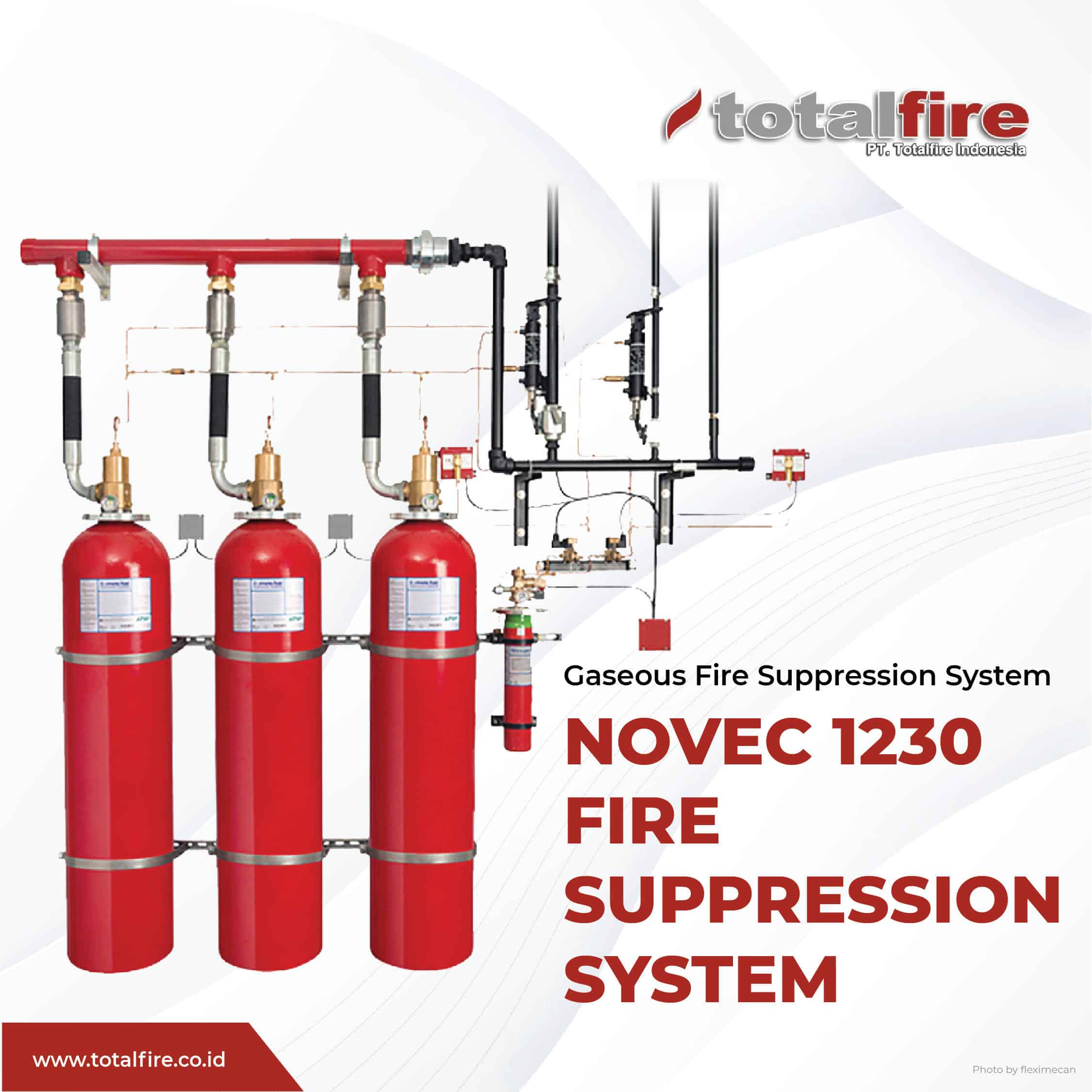
Novec 1230
Fire Suppression System
Category: Gaseous Fire Suppression System
Novec 1230 Fire Suppression System — The World’s Most Environmentally Sustainable Clean Agent for Indonesia’s Critical Facilities
PT Totalfire Indonesia designs and installs Novec 1230 fire suppression systems for data centers, server rooms, control rooms, museums, archives, laboratories, and other high-value environments across Indonesia. Novec 1230 represents the current pinnacle of clean agent fire suppression technology — combining fast suppression speed, zero residue discharge, the highest human safety margin of any clean agent, and near-zero environmental impact into a single system.
For organizations with sustainability commitments, ESG reporting obligations, or long-term regulatory planning requirements around HFC phase-down policies, Novec 1230 is the only clean agent that delivers equivalent fire suppression performance to FM-200 while being fully future-proof from an environmental compliance standpoint.
All our Novec 1230 system designs comply with NFPA 2001 (Standard on Clean Agent Fire Extinguishing Systems) and ISO 14520-5 (Gaseous Fire-Extinguishing Systems — FK-5-1-12), backed by our ISO 9001:2015 and ISO 45001:2018 certifications.
What Is Novec 1230?
Novec 1230 (chemical name: dodecafluoro-2-methylpentan-3-one, also designated FK-5-1-12) is a next-generation clean agent fire suppressant developed originally by 3M as a sustainable replacement for HFC-based clean agents including FM-200. It is a colorless, odorless, electrically non-conductive liquid at room temperature that vaporizes rapidly upon discharge to flood a protected enclosure as a gas.
Novec 1230 has a boiling point of 49°C — stored as a liquid under its own vapor pressure, it requires no pressurization for storage (unlike many other clean agents). When the system activates, Novec 1230 is expelled from its cylinders using nitrogen pressure, travels through the distribution piping as a liquid, and vaporizes as it exits the discharge nozzles — flooding the protected volume uniformly as a gas within seconds.
The agent suppresses fire primarily through heat absorption: Novec 1230 has an exceptionally high heat of vaporization, absorbing large quantities of thermal energy from the combustion zone as it vaporizes, rapidly reducing the fire’s energy below the self-sustaining combustion threshold.
Novec 1230’s Unique Environmental Credentials
No other fire suppression agent — clean agent, inert gas, or conventional — matches Novec 1230’s combination of environmental performance metrics. These are not marketing claims but measurable physical and chemical properties:
| Environmental Property | Novec 1230 | FM-200 (HFC227ea) | Inert Gas (IG-541) | CO₂ |
|---|---|---|---|---|
| Ozone Depletion Potential (ODP) | ✅ Zero | ✅ Zero | ✅ Zero | ✅ Zero |
| Global Warming Potential (100-year) | ✅ <1 | ❌ 3,220 | ✅ Zero | 1 (reference) |
| Atmospheric Lifetime | ✅ 5 days | ❌ 34.2 years | ✅ Natural (no persistence issue) | Variable |
| HFC Phase-Down Risk | ✅ None (non-HFC) | ❌ High (regulated HFC) | ✅ None | ✅ None |
| SNAP Approved (US EPA) | ✅ Yes | ✅ Yes (with conditions) | ✅ Yes | ✅ Yes |
Novec 1230’s atmospheric lifetime of just 5 days is the shortest of any fire suppression agent — compared to FM-200’s 34-year atmospheric persistence. This means that even if a Novec 1230 system discharges, the agent breaks down naturally within days with negligible cumulative environmental impact. This is the core reason Novec 1230 is described as the most sustainable halon alternative available and why organizations with science-based emissions targets increasingly specify it over FM-200.
Key Advantages of Novec 1230 Fire Suppression
Highest Human Safety Margin of Any Clean Agent
Novec 1230 has a NOAEL (No Observed Adverse Effect Level) of 10% by volume — the highest of any clean agent specified in NFPA 2001. Its design concentration of 5.3–5.6% by volume is significantly below this NOAEL, providing a safety margin of nearly 2:1 between the working concentration and the level at which any adverse effects would be observed. This is the widest safety margin of any commercially used clean agent, giving Novec 1230 the best human safety profile in the clean agent category.
Fast Suppression — 10 Seconds or Less
Despite working purely through heat absorption (with no chemical combustion chain interference), Novec 1230 achieves fire suppression in 10 seconds or less at its design concentration — matching FM-200’s suppression speed. This is possible because of Novec 1230’s extremely high heat of vaporization: the agent absorbs enormous quantities of thermal energy as it vaporizes in the fire zone, collapsing the combustion process faster than an oxygen-depleting agent could achieve at equivalent concentration.
Zero Residue — Zero Secondary Damage
Novec 1230 is neither corrosive nor electrically conductive. It leaves absolutely no residue after discharge — the agent simply vaporizes and disperses. Protected servers, switchgear, archival documents, artworks, and instruments are in exactly the same condition post-discharge as they were before, except the fire is out. Equipment inspection and return to service can begin immediately after ventilation — without decontamination, drying time, or equipment cleaning costs.
Lowest Design Concentration of Any Clean Agent
At a design concentration of just 5.3–5.6% by volume, Novec 1230 requires less agent to protect the same volume than FM-200 (7–8%) or CO2 (34%). This translates directly into fewer cylinders, smaller cylinder storage footprint, and lower agent cost per protected cubic meter — partially offsetting the higher per-kilogram cost of Novec 1230 compared to FM-200.
Stored as a Liquid — Compact Footprint
Novec 1230 is stored as a liquid under its own vapor pressure, with nitrogen used only as an expellant. The liquid storage density means that Novec 1230 achieves a cylinder footprint comparable to FM-200 — significantly smaller than inert gas systems that require multiple large high-pressure cylinders to store equivalent suppression capacity in gaseous form.
Suitable for All Fire Classes
Novec 1230 effectively suppresses Class A (ordinary combustibles), Class B (flammable liquids), and Class C (electrical) fires — making it suitable for the complete range of hazards found in data centers, control rooms, and other protected environments where multiple fire hazard classes may be present simultaneously.
Future-Proof Regulatory Compliance
With a GWP of less than 1 and an atmospheric lifetime of just 5 days, Novec 1230 is not subject to HFC phase-down regulations and is unlikely to face regulatory restrictions in any foreseeable future regulatory scenario. Organizations installing FM-200 systems today face a real risk that tightening HFC regulations — already in progress in the EU and under discussion globally — could restrict FM-200 recharging or require system replacement within the system’s operational lifetime. Novec 1230 eliminates this risk entirely.
How a Novec 1230 System Works
- Continuous Detection — Cross-zoned smoke detectors (typically two independent detection zones) monitor the protected enclosure 24 hours a day. A single zone activating triggers pre-alarm only
- Pre-Discharge Alarm — When the cross-zone condition is confirmed (both zones activated), audible multi-tone sounders and visual strobes activate inside and at all access doors to the protected space — mandatory evacuation warning
- Pre-Discharge Time Delay — A programmable countdown (typically 30 seconds per NFPA 2001) allows complete evacuation before agent release. The abort station can halt the sequence if the alarm is determined false
- HVAC Shutdown & Enclosure Sealing — HVAC systems serving the protected space de-energize and fire-rated dampers close automatically, sealing the enclosure to retain Novec 1230 at design concentration during the hold period
- Cylinder Valve Opens — The solenoid actuator opens the cylinder valve, releasing Novec 1230 under nitrogen expellant pressure into the distribution piping
- Liquid-to-Gas Discharge — Novec 1230 travels through the piping as a liquid and vaporizes as it exits the precision-orificed discharge nozzles, flooding the protected volume uniformly as a gas within 10 seconds
- Fire Suppression — Novec 1230 absorbs heat from the combustion zone, rapidly reducing the fire’s energy below the self-sustaining threshold. Oxygen levels in the room remain normal — no oxygen depletion occurs
- Hold Period — Per NFPA 2001 and ISO 14520-5, a minimum of 85% of design concentration must be maintained for at least 10 minutes after discharge to ensure complete suppression and prevent re-ignition
- Post-Discharge Ventilation — After fire suppression is confirmed by qualified personnel, the space is ventilated. Novec 1230 disperses within minutes — its 5-day atmospheric lifetime means even the ventilated agent has negligible environmental impact
- System Recharge — Discharged cylinders are sent for recharging. The system is reset to automatic standby
Novec 1230 vs. FM-200 — The Detailed Comparison
Novec 1230 and FM-200 are the two leading clean agent options for data centers and server rooms. Both suppress fire in 10 seconds and leave zero residue — but they differ significantly on several important dimensions:
| Feature | Novec 1230 (FK-5-1-12) | FM-200 (HFC227ea) |
|---|---|---|
| Chemical classification | Fluoroketone (FK) | Hydrofluorocarbon (HFC) |
| Suppression mechanism | Heat absorption (thermodynamic) | Heat absorption + chemical chain reaction interruption |
| Design concentration | ✅ 5.3–5.6% (lower agent requirement) | 7–8% |
| Discharge time | ✅ ≤10 seconds | ✅ ≤10 seconds |
| NOAEL (safety limit) | ✅ 10% (highest among clean agents) | 9% |
| Safety margin | ✅ ~1.9× (10% ÷ 5.3%) | ~1.2× (9% ÷ 7.5%) |
| Residue after discharge | None | None |
| Electrically non-conductive | ✅ Yes | ✅ Yes |
| Global warming potential | ✅ <1 | ❌ 3,220 |
| Atmospheric lifetime | ✅ 5 days | ❌ 34.2 years |
| HFC phase-down exposure | ✅ None (non-HFC) | ❌ High (regulated HFC) |
| Storage state | Liquid (low vapor pressure) | Liquid (nitrogen-pressurized) |
| Cylinder footprint | Compact | Compact |
| Agent cost | Higher | Lower |
| Availability (Indonesia) | ⚠️ Limited (import) | ✅ Readily available |
| Governing standard | NFPA 2001 / ISO 14520-5 | NFPA 2001 |
Bottom line: Choose Novec 1230 when environmental performance, long-term regulatory compliance, or the widest human safety margin are priorities. Choose FM-200 when agent cost, local availability, and the most proven global installation track record take precedence. Both deliver equivalent fire suppression performance for data centers and server rooms. Our engineering team can advise on the optimal choice for your specific facility. See our FM-200 system page for full details on that option.
Where Is Novec 1230 Used?
Data Centers & Server Rooms
Novec 1230 is increasingly specified for new data center builds and retrofits by organizations with ESG commitments, sustainability reporting obligations, or those operating under green building frameworks (LEED, EDGE, GREENSHIP). Its near-zero environmental impact profile allows sustainability managers to include fire suppression as a net-zero-aligned facility decision for the first time.
Control Rooms & SCADA Facilities
Process control rooms and SCADA facilities in power generation, oil & gas, and industrial manufacturing specify Novec 1230 when environmental credentials are required alongside the residue-free, zero-downtime suppression performance that these critical spaces demand.
Museums, Heritage Buildings & Cultural Institutions
Museums, art galleries, libraries, and heritage facilities protecting irreplaceable collections specify Novec 1230 for two reasons: it is entirely non-reactive with artworks, documents, and artifacts at any exposure duration, and its near-zero environmental impact aligns with the sustainability missions of most cultural institutions. Novec 1230 is safe for papers, canvas, pigments, metals, and sensitive organic materials — no artifact damage, no residue, no cleanup.
Archival & Document Storage
Government archives, legal record facilities, financial document vaults, and media libraries specify Novec 1230 where both zero residue suppression and environmental compliance are required. The agent’s complete non-reactivity with paper, film, magnetic media, and binding materials makes it the safest clean agent option for archival storage.
Laboratories & Pharmaceutical Facilities
Research laboratories, pharmaceutical manufacturing quality control rooms, and analytical instrument rooms contain equipment and materials that cannot be exposed to water, foam, or chemical residue. Novec 1230’s clean discharge and high human safety margin make it ideal for environments where personnel may be present when suppression occurs.
Telecommunications & Network Infrastructure
Telecommunications exchange buildings, BTS equipment rooms, and network operations centers that have adopted green building or sustainability frameworks specify Novec 1230 as the clean agent that aligns with their environmental commitments without compromising protection performance.
UPS Rooms & Electrical Switchgear
High-value UPS systems, main distribution boards, and electrical switchgear rooms benefit from Novec 1230’s electrical non-conductivity and zero-residue discharge — the agent can be safely discharged into energized electrical environments without risk of short circuit or equipment contamination.
Banking, Finance & Insurance Facilities
Banks, financial institutions, and insurance companies protecting server infrastructure, trading systems, and document vaults increasingly specify Novec 1230 as part of their ESG and green finance commitments, recognizing that fire suppression agent selection is a quantifiable component of a facility’s environmental impact reporting.
Key Components of a Novec 1230 Fire Suppression System
- Novec 1230 Cylinder Assembly — Cylinders containing liquefied Novec 1230 with nitrogen expellant; sized for the total agent quantity required for the protected volume. Because of Novec 1230’s low design concentration (5.3–5.6%), fewer cylinders are typically required than for FM-200 for the same protected volume
- Cylinder Valve & Solenoid Actuator — Opens automatically on signal from the control panel; mechanical pull-pin provides manual backup activation independent of electrical power
- Liquid Distribution Piping — Novec 1230 travels through the piping network as a liquid (unlike gaseous clean agents), vaporizing at the nozzle orifice — allowing smaller pipe diameters than equivalent gas-phase systems
- Discharge Nozzles — Precision-orificed nozzles positioned by hydraulic calculation to achieve uniform agent distribution throughout the protected volume within the 10-second discharge time. Nozzle design accounts for the liquid-to-gas phase transition at the orifice
- Suppression Control Panel — Manages detection input, pre-discharge sequence, time delay, abort function, and solenoid valve actuation. Provides automatic and manual modes; battery-backed for operation during power failure. Integrates with the building fire alarm system
- Cross-Zoned Smoke Detectors — Typically addressable photoelectric or VESDA (Very Early Smoke Detection Apparatus) detectors in cross-zone configuration; two zones must activate to initiate the suppression sequence
- Pre-Discharge Warning Devices — Audible multi-tone sounders (minimum 94 dB) and visual strobes inside the protected space and at all access points
- Abort Station — Allows authorized personnel to halt the discharge countdown if the alarm is determined to be false; must be actively held throughout the delay period to prevent discharge
- Gas Discharge Indicator Lamps — Illuminate above all access doors when the discharge sequence is active, warning personnel not to enter
- HVAC Shutdown & Door Release Interface — Automatically de-energizes HVAC systems and closes fire dampers on alarm to seal the protected enclosure
- Cylinder Pressure Monitoring — Continuous pressure monitoring with low-pressure supervisory alarm if agent loss from leakage is detected between inspections
Enclosure Integrity — Essential for Novec 1230 Systems
Per NFPA 2001 and ISO 14520-5, a minimum of 85% of the design Novec 1230 concentration must be maintained for at least 10 minutes after discharge. Leaks through cable penetrations, raised floor openings, unsealed HVAC connections, and door gaps allow agent to escape and atmospheric air to re-enter — potentially allowing re-ignition before the hold period is complete.
PT Totalfire Indonesia performs mandatory door fan enclosure integrity testing (per ISO 14520 Annex C and NFPA 2001 Annex B) at commissioning of every Novec 1230 system. The test uses a calibrated fan to measure the enclosure’s equivalent leakage area and calculate predicted agent retention time. All leak points are identified and sealed before the system is certified. This is a standard — not optional — component of our commissioning scope for every gaseous suppression system installation.
Our Novec 1230 System EPC Process
- Site Survey & Enclosure Assessment — We survey the protected space: dimensions, ceiling height, raised floor depth, false ceiling void, penetrations, HVAC connections, door sealing condition, and existing detection infrastructure. Special attention is given to enclosure conditions that affect agent retention
- Agent Quantity Calculation — Full NFPA 2001 / ISO 14520-5-compliant calculation: net protected volume (accounting for equipment displacement and raised floor/false ceiling voids), design concentration (5.3–5.6% for Class A/B/C hazards), temperature correction factor for Indonesia’s ambient temperature conditions, and altitude correction for the installation location
- Hydraulic System Design — Cylinder sizing, liquid distribution piping design, nozzle selection and placement, and hydraulic pressure calculations to verify uniform Novec 1230 distribution throughout the protected volume within the 10-second discharge time, accounting for the liquid-to-gas phase transition at nozzle orifices
- Detection System Design — Cross-zoned detector layout (VESDA recommended for raised floor data center applications), control panel specification, and integration design for fire alarm panel, HVAC controls, door releases, and access control systems
- Equipment Procurement — Novec 1230 cylinders pre-filled with agent, cylinder valves and solenoid actuators, distribution piping and fittings, discharge nozzles, control panel, smoke detectors, sounders, strobes, abort stations, and door hardware from certified manufacturers and authorized distributors
- Installation — Cylinder rack and bracket installation, liquid distribution piping fabrication and installation, nozzle mounting and orientation, control panel wiring, detector installation, sounder and strobe installation, abort station wiring, HVAC damper interface, and door release installation
- Commissioning & Integrity Test — Full system functional test: cross-zone activation simulation, time delay verification, abort station function, HVAC shutdown and door release confirmation — followed by mandatory door fan enclosure integrity test per ISO 14520-5 / NFPA 2001 Annex B to verify agent retention time
- Personnel Training — Training for facility and security personnel on system operation, pre-discharge alarm signals, evacuation protocol, abort station operation, post-discharge ventilation and oxygen monitoring, and return-to-service procedure
- Ongoing Maintenance — Annual inspection per NFPA 2001 and ISO 14520-5: cylinder weight verification, solenoid and actuator inspection, detector functional test, control panel battery test, nozzle inspection, and enclosure integrity re-test as required
For post-commissioning system care, visit our Service & Maintenance page.
Other Gaseous Fire Suppression Systems We Install
- FM-200 (HFC227ea) System — The most widely installed clean agent globally; ideal when agent cost and local availability take priority over environmental performance
- Inert Gas System — Zero GWP naturally occurring gas blend; for applications where zero environmental impact from the agent itself is the primary requirement
- CO2 System — Cost-effective total flooding and local application suppression for unoccupied industrial hazards, turbines, and process equipment
Related Fire Protection Systems
- Sprinkler System — Automatic water-based suppression for the broader facility surrounding the Novec 1230-protected enclosure
- Wet Pipe System — For offices, corridors, and common areas adjacent to the protected server room or archive
- Fire Hydrant System — Manual large-scale suppression for the overall facility
- Water Spray System — For transformer and industrial equipment protection in the same facility
Frequently Asked Questions — Novec 1230 Fire Suppression Systems
What makes Novec 1230 more environmentally sustainable than FM-200?
The difference is dramatic and measurable. FM-200 (HFC-227ea) has a global warming potential (GWP) of 3,220 — meaning each kilogram of FM-200 discharged has the same greenhouse effect as 3,220 kg of CO2 over 100 years — and it persists in the atmosphere for 34.2 years. Novec 1230 has a GWP of less than 1 and an atmospheric lifetime of just 5 days. A discharged Novec 1230 cylinder breaks down naturally within a week with negligible climate impact. For organizations with science-based emissions targets or ESG reporting requirements, specifying Novec 1230 over FM-200 is a material and measurable sustainability decision.
Is Novec 1230 safe if someone is in the room when it discharges?
Novec 1230 has the highest human safety margin of any clean agent specified in NFPA 2001. Its NOAEL (No Observed Adverse Effect Level) is 10% by volume, while its design concentration is 5.3–5.6% — a safety ratio of nearly 2:1. At design concentration, no adverse physiological effects are expected from brief exposure. This compares favorably to FM-200, whose NOAEL is 9% against a design concentration of 7–8% (safety ratio of approximately 1.2:1). As with all clean agent systems, evacuation is always mandatory before or immediately upon discharge — the NOAEL is a safety margin, not an authorization to remain in the space during suppression.
Why does Novec 1230 have a lower design concentration than FM-200?
Novec 1230 has an exceptionally high heat of vaporization — approximately ten times higher than FM-200 per unit volume. When it vaporizes in the fire zone, it absorbs far more thermal energy per molecule than FM-200, making it effective at lower concentrations. The practical result is that a Novec 1230 system requires less agent by volume to protect the same enclosure than an FM-200 system — partially offsetting Novec 1230’s higher per-kilogram cost through reduced agent quantity requirements.
Is Novec 1230 still being manufactured and available in Indonesia?
Novec 1230 is produced and distributed globally. In Indonesia, Novec 1230 is available through authorized distributors and agents, though availability is more limited than FM-200 which has been established in the Indonesian market for longer. PT Totalfire Indonesia works with certified suppliers for Novec 1230 procurement and can advise on current agent availability and lead times at the time of your project. For facilities where long-term local recharge availability is a primary concern, FM-200 may have a practical advantage — our engineers will discuss this trade-off transparently as part of the agent selection consultation.
Can Novec 1230 replace an existing FM-200 system?
Novec 1230 and FM-200 are not directly interchangeable — they have different design concentrations, different agent quantities, and different nozzle and piping requirements. A direct cylinder swap is not possible. However, retrofitting an existing FM-200 system to Novec 1230 is technically feasible and is done regularly globally: the existing piping network may be reusable in many cases, while cylinders, nozzles, and agent are replaced and the hydraulic calculations are redone for the new agent. PT Totalfire Indonesia can assess existing FM-200 installations and provide a retrofit feasibility study and cost estimate on request.
How does Novec 1230 compare to inert gas systems?
Both Novec 1230 and inert gas systems have near-zero environmental impact — Novec 1230’s GWP is less than 1 and inert gas has zero GWP. The key operational differences are suppression speed (Novec 1230 suppresses in 10 seconds vs. approximately 60 seconds for inert gas), storage footprint (Novec 1230’s liquid storage is significantly more compact than inert gas’s large high-pressure cylinder banks), and suppression mechanism (Novec 1230 absorbs heat; inert gas reduces oxygen). For applications where suppression speed is critical — live server rooms, active switchgear — Novec 1230’s 10-second performance is a decisive advantage. For applications where absolutely zero GWP and zero synthetic chemical release are required — heritage facilities, certain museum collections — inert gas’s purely natural composition may be preferred. See our Inert Gas System page for full details.
How often does a Novec 1230 system require maintenance?
Per NFPA 2001 and ISO 14520-5, Novec 1230 systems require annual inspection including: cylinder weight verification (agent quantity check — cylinders with more than 5% agent loss must be recharged), solenoid and actuator inspection, smoke detector functional test, control panel battery test, nozzle visual inspection, and enclosure integrity assessment. A full door fan integrity test should be repeated every two to three years or after any significant penetration work in the protected enclosure. PT Totalfire Indonesia provides annual maintenance contracts covering all required inspection and testing activities. Contact us to discuss a maintenance agreement.
PT. Totalfire Indonesia
PT. Totalfire Indonesia, established in May 2005, is a trusted fire protection system contractor in Jakarta, Indonesia. As a fire protection specialist with ISO 45001 and ISO 9001 certification, we provide engineering, installation, and maintenance services for fire protection systems across commercial and industrial projects, ensuring compliance with NFPA and SNI standards.
Market Range
Industrial Building
Power Plant
Mining Company
Oil and Gas Company
Telecommunication Company
Commercial Building
Residential Building
Contact Us
Ruko Prominence Alam Sutera, Blok 38E No.49
Jl Jalur Sutera, Panunggangan Timur, Pinang
Tangerang Selatan, Banten - Indonesia 15325