
PT. Totalfire Indonesia
Gaseous Fire Suppression System
Contractor in Indonesia
PT Totalfire Indonesia designs and installs gaseous fire suppression systems for data centers, server rooms, control rooms, electrical switchgear rooms, telecommunications facilities, museums, archives, and industrial process areas across Indonesia. Where water-based suppression would cause catastrophic secondary damage to equipment, data, or irreplaceable assets, gaseous systems provide fast, effective, residue-free fire suppression that protects both lives and property.
We supply and install all four major gaseous suppression agent types: Carbon Dioxide (CO2), FM-200 (HFC227ea), Novec 1230, and Inert Gas — each engineered to the specific enclosure volume, hazard classification, and occupancy requirements of your facility. All systems comply with NFPA 2001, NFPA 12, and ISO 14520, backed by our ISO 9001:2015 and ISO 45001:2018 certifications.
Our Gaseous Suppression System Services

Carbon Dioxide (CO2) Fire Suppression System
CO2 extinguishes fire by rapidly displacing oxygen and absorbing heat energy. A naturally occurring, electrically non-conductive, residue-free agent — effective for both total flooding (sealed rooms) and local application (open equipment). The most cost-effective gaseous agent with wide local recharge availability in Indonesia. Important: CO2 at suppression concentrations is hazardous to humans — suitable for normally unoccupied areas only.
Best for: Turbines, transformers, rolling mills, hydraulic systems, cable trays, paint booths, print machinery, engine rooms, switchgear rooms — all normally unoccupied industrial hazards.
Standard: NFPA 12

FM-200 (HFC227ea) Fire Suppression System
The world’s most widely installed clean agent — deployed in over 100,000 systems across 70+ countries. FM-200 suppresses fire in 10 seconds or less through heat absorption and chemical chain interruption. Electrically non-conductive, zero residue, and safe for occupied spaces at design concentration (7–8% by volume). Compact storage footprint. The established benchmark for server room and data center protection in Indonesia.
Best for: Data centers, server rooms, UPS rooms, control rooms, telecommunications facilities, electrical switchgear, laboratories.
Standard: NFPA 2001
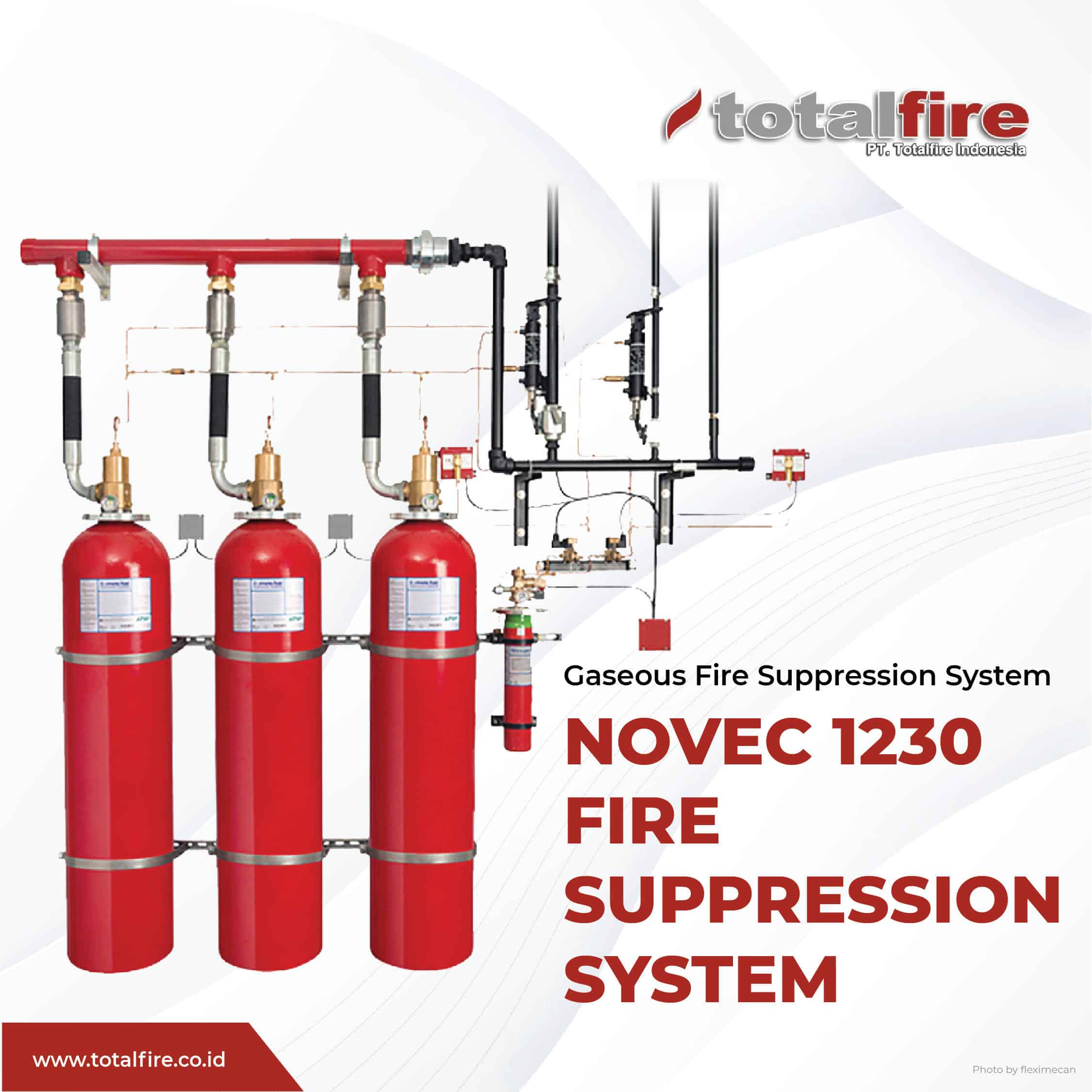
Novec 1230 Fire Suppression System
Next-generation clean agent with the best environmental credentials of any clean agent: GWP <1 and atmospheric lifetime of just 5 days — compared to FM-200’s GWP of 3,220 and 34-year atmospheric persistence. Suppresses fire in 10 seconds, leaves zero residue, and has the highest human safety margin of any clean agent (NOAEL: 10%). The preferred choice for organizations with ESG commitments or long-term regulatory planning requirements around HFC phase-down.
Best for: Data centers, server rooms, museums, archives, control rooms, and any ESG-committed facility requiring the most sustainable clean agent technology.
Standard: NFPA 2001 / ISO 14520-5
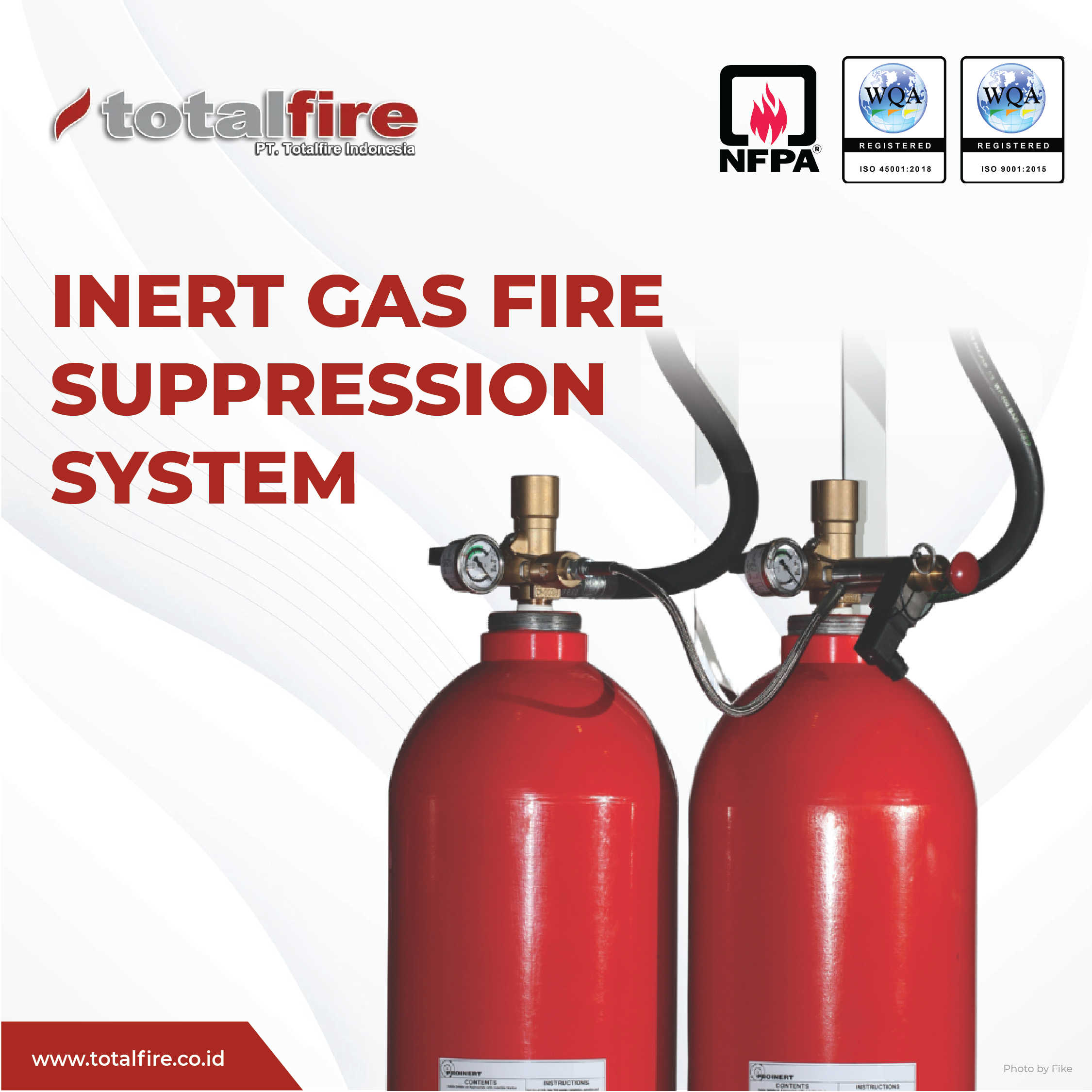
Inert Gas Fire Suppression System
Naturally occurring atmospheric gas blends — IG-541 (Inergen), IG-55 (Argonite), IG-100 (Nitrogen), IG-01 (Argon) — with zero ODP and zero GWP. Works by reducing oxygen to below the combustion threshold while remaining safe for brief human occupancy. Leaves no residue, no decomposition products, and no environmental impact. Higher cylinder storage footprint than clean agents but unmatched environmental purity.
Best for: Archives, museums, heritage buildings, data centers with zero-GWP requirements, control rooms, telecommunications rooms.
Standard: NFPA 2001 / ISO 14520
Choosing the Right Gaseous Suppression Agent
| Agent | Suppression Time | Safe for Occupied Spaces | GWP | Best Suited For |
|---|---|---|---|---|
| CO2 | ~60 sec | ❌ No | 1 | Unoccupied industrial hazards — lowest cost |
| FM-200 | ✅ ≤10 sec | ✅ Yes | 3,220 | Server rooms, data centers — speed priority |
| Novec 1230 | ✅ ≤10 sec | ✅ Yes (highest margin) | <1 | Server rooms + ESG/environmental priority |
| Inert Gas | ~60 sec | ✅ Yes | Zero | Archives, museums — zero environmental impact |
The right agent depends on occupancy (is the space normally occupied?), required suppression speed, environmental policy, and available storage space. Our engineers assess all four factors and recommend the optimal agent for your application — free of charge as part of our initial consultation.
When Is Gaseous Suppression the Right Choice?
Gaseous systems are the specified solution when one or more of the following conditions apply:
- The protected space contains high-value electronic equipment that water would destroy — servers, UPS systems, switchgear, control panels
- The facility stores irreplaceable assets — archival documents, museum collections, magnetic media, or laboratory instruments
- Water-based suppression is operationally prohibited due to electrical hazard, process sensitivity, or equipment damage risk
- Fast automatic suppression is critical — with zero tolerance for secondary water damage
- The facility requires minimal downtime after a fire event — no cleanup, no decontamination, back in service after ventilation
Industries We Serve
- Data Centers & IT Infrastructure — FM-200 or Novec 1230 for live server rooms; pre-action wet pipe for the broader facility
- Telecommunications — BTS equipment rooms, NOC facilities, exchange buildings
- Power Generation — CO2 and clean agent systems for turbine enclosures, cable rooms, and control systems
- Oil & Gas — CO2 for machinery spaces and process equipment; clean agents for control rooms
- Banking & Finance — FM-200 or Novec 1230 for server infrastructure, trading systems, and document vaults
- Cultural Institutions — Inert gas or Novec 1230 for museums, galleries, and heritage facilities
- Industrial Manufacturing — CO2 local application for process equipment and machinery
- Healthcare — Clean agent protection for diagnostic equipment rooms and medical IT infrastructure
Related Services
- Fire Fighting System — Water-based suppression for the broader facility surrounding gaseous-protected enclosures
- Detection System — Fire alarm and early warning systems that trigger gaseous suppression
- Service & Maintenance — Annual inspection and maintenance contracts for gaseous systems per NFPA 2001
Frequently Asked Questions
What is the difference between a clean agent and CO2 suppression?
The critical difference is personnel safety. CO2 at suppression concentrations displaces oxygen to immediately life-threatening levels — making it suitable only for normally unoccupied areas. Clean agents (FM-200, Novec 1230) and inert gas systems suppress fire at concentrations specifically designed to remain safe for brief human exposure, making them suitable for data centers, control rooms, and other spaces with regular occupancy.
How quickly does a gaseous system suppress a fire?
Clean agents (FM-200 and Novec 1230) achieve design concentration and suppress fire in 10 seconds or less from the moment of discharge. Inert gas and CO2 systems typically take approximately 60 seconds to reach design concentration. The pre-discharge delay (typically 30 seconds for evacuation) occurs before discharge begins — total elapsed time from detection to suppression is typically 60–90 seconds for clean agents.
Does a gaseous system require a sealed room?
Yes. For a gaseous system to work, the protected enclosure must retain the agent at design concentration for the required hold period — typically 10 minutes per NFPA 2001. PT Totalfire Indonesia performs mandatory door fan enclosure integrity testing (per ISO 14520) during commissioning of every gaseous system to verify agent retention time. All identified leaks are sealed before the system is certified operational.
Can one gaseous system protect multiple rooms?
Yes. Multi-zone systems use selector valves to direct agent from a shared cylinder bank to the specific zone where fire is detected. This is common in facilities with multiple server rooms, UPS rooms, and control rooms requiring independent protection — reducing total cylinder count and floor space compared to separate single-zone systems for each room.