
Fire Fighting system
Water Spray System
Category: Fire Fighting System
Water Spray System — Fixed Fire Protection for Industrial Equipment & High-Hazard Facilities
PT Totalfire Indonesia designs and installs fixed water spray systems for industrial plants, power generation facilities, oil & gas infrastructure, and other high-hazard environments across Indonesia. Our systems are engineered in full compliance with NFPA 15 (Standard for Water Spray Fixed Systems for Fire Protection) and SNI national regulations, backed by our ISO 9001:2015 and ISO 45001:2018 certifications.
What Is a Water Spray System?
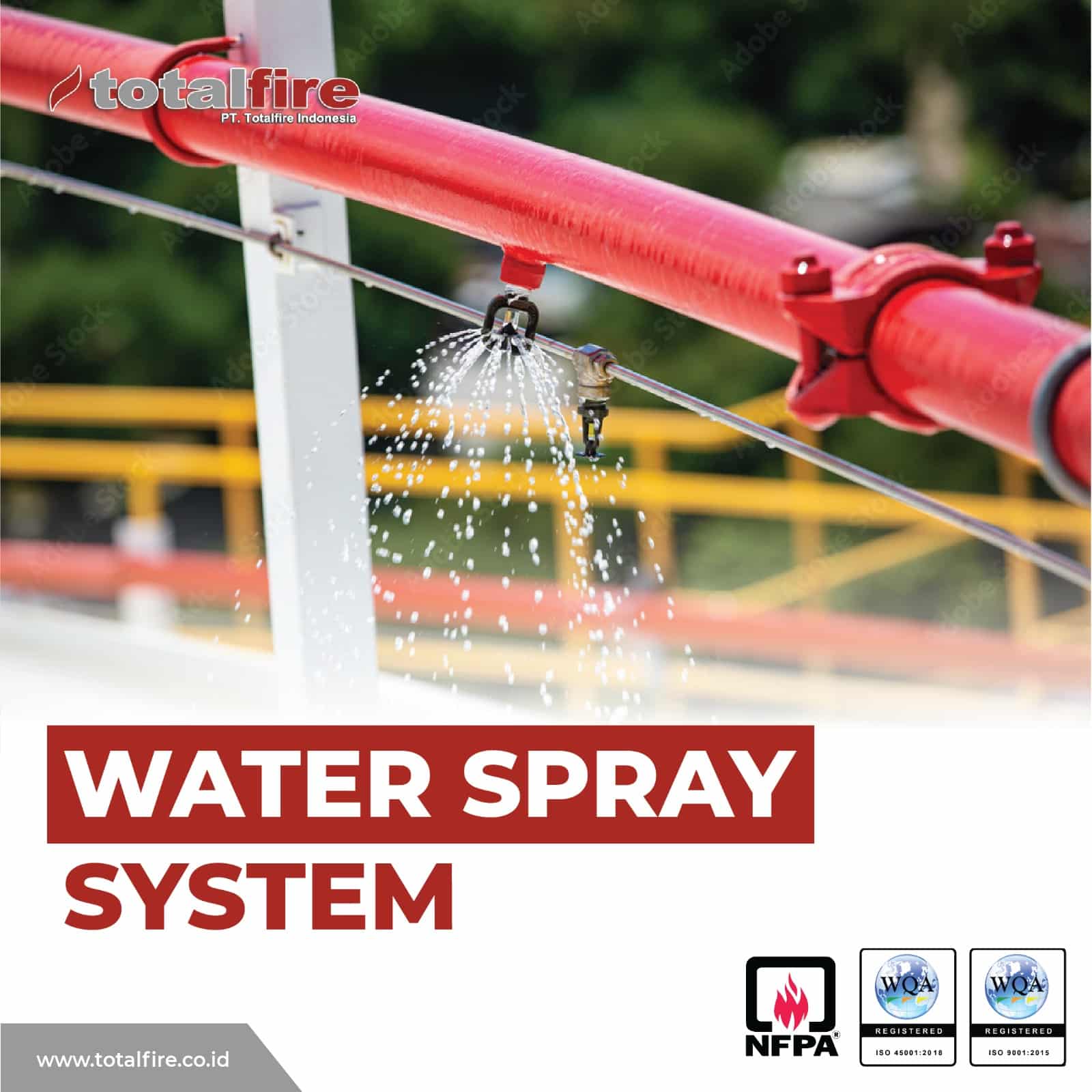
A fixed water spray system is a special-application fire suppression and exposure protection system that discharges water through open nozzles designed to produce specific spray patterns — oval, fan, full-circle, or narrow jet — to conform precisely to the three-dimensional geometry of the equipment being protected.
Unlike a standard sprinkler system that discharges water downward over a floor area, a water spray system is engineered to envelop specific equipment or structures from multiple angles simultaneously. This makes it the correct solution wherever the hazard is a piece of equipment — not a room.
Operationally, a water spray system functions like a deluge system: the piping is dry under normal conditions, and all nozzles in the zone open simultaneously when a fire detection signal triggers the deluge valve. The key distinction is in the engineering intent — deluge systems protect horizontal floor areas, while water spray systems protect three-dimensional equipment surfaces and structures.
How a Water Spray System Works
- Detection — A fire or heat detection device (smoke detector, heat detector, linear heat detection cable, or UV/IR flame detector) monitors the protected area continuously
- Signal — Upon detection, the system sends an automatic signal to the deluge valve control panel
- Valve Opens — The deluge valve releases, allowing pressurized water to fill the previously dry piping network
- Simultaneous Discharge — All open nozzles in the zone discharge simultaneously, applying water across the entire protected surface within seconds
- Suppression & Cooling — Water spray suppresses flame, cools equipment surfaces, and prevents re-ignition or exposure spread to adjacent equipment
- Reset — After the fire is controlled and the system is manually inspected, the deluge valve is reset and the system returns to standby
What Does a Water Spray System Protect?
Water spray systems are the specified fire protection solution for equipment and structures where the geometry, hazard type, or regulatory requirement demands directed, multi-angle water application. Common protected assets include:
Electrical Transformers (Oil-Filled)
Oil-filled power transformers are one of the most critical and most common applications for water spray systems. The system cools the transformer casing, suppresses oil fires, and prevents catastrophic failure from spreading to adjacent transformers or switchgear. Nozzles are positioned to achieve full surface coverage of the transformer tank, conservator, bushings, and cable terminations. Designed per NFPA 15 and widely required by PLN and independent power producers across Indonesia.
Turbine Generators & Turbo-Generator Bearings
Gas and steam turbines present a high fire risk due to lubricating oil systems operating at elevated temperatures. Water spray systems protect turbine bearing housings, lube oil tanks, and generator exciter ends with precisely angled nozzles that cover curved surfaces a conventional sprinkler head cannot reach.
Flammable Liquid Storage Tanks (External Cooling)
Fixed water spray systems are installed on the external shell of above-ground storage tanks containing flammable or combustible liquids (crude oil, refined petroleum products, chemicals). In the event of a fire, the spray system cools the tank shell to prevent thermal stress, boil-over, or BLEVE (Boiling Liquid Expanding Vapor Explosion) while suppressing the fire at the tank periphery. Designed per NFPA 15 and API 2030 guidelines.
LPG & Pressurized Gas Vessels
Water spray deluge systems on LPG bullets and spheres keep vessel surfaces below critical temperature during a fire emergency, preventing pressure relief valve activation and potential BLEVE. This application is standard in petrochemical plants, LPG terminals, and gas distribution stations.
Process Equipment & Pumping Stations
Pump sets, heat exchangers, reactors, and other process equipment in chemical plants, refineries, and industrial facilities are routinely protected by water spray systems when the equipment handles flammable or combustible liquids above their flash point.
Cable Trays & Electrical Infrastructure
In power plants and large industrial facilities, cable trays carrying high-voltage power cables are protected by water spray or water mist systems to suppress insulation fires before they propagate across cable runs.
Water Spray System vs. Deluge System — Key Differences
| Feature | Water Spray System | Deluge System |
|---|---|---|
| Design intent | Protect 3D equipment surfaces | Cover horizontal floor area of a room |
| Nozzle type | Open directional nozzles (oval, fan, full-circle, jet) | Open sprinkler heads (uniform pattern) |
| Activation | Deluge valve via detection system | Deluge valve via detection system |
| Piping condition | Dry (filled only on activation) | Dry (filled only on activation) |
| Primary application | Transformers, tanks, turbines, vessels | Aircraft hangars, paint booths, high-hazard rooms |
| Governing standard | NFPA 15 | NFPA 13, NFPA 16 |
If your hazard involves protecting a room or floor area rather than specific equipment, see our Foam System or Wet Pipe Sprinkler System pages for the appropriate solution.
Water Spray System vs. Other Fire Suppression Options
| Criteria | Water Spray System | Foam System | Gaseous System (FM-200 / Novec) |
|---|---|---|---|
| Best for | Equipment cooling & exposure protection | Flammable liquid surface fires | Enclosed spaces, sensitive electronics |
| 3D equipment coverage | ✅ Excellent | ⚠️ Limited to surface blanket | ✅ Full enclosure fill |
| Tank/vessel cooling | ✅ Primary application | ❌ Not designed for this | ❌ Not applicable |
| Safe for personnel | ✅ Yes | ✅ Yes | ⚠️ CO2 hazardous; FM-200/Novec safer |
| Outdoor installation | ✅ Yes | ✅ Yes | ❌ No (pressurized gas) |
| NFPA standard | NFPA 15 | NFPA 11, NFPA 16 | NFPA 12, NFPA 2001 |
Our Water Spray System EPC Process
PT Totalfire Indonesia delivers water spray system projects on a full Engineering, Procurement & Construction (EPC) basis — from initial hazard assessment through commissioning and regulatory documentation:
- Site Survey & Hazard Classification — We assess the equipment type, flammable material, operating conditions, and surrounding exposure hazards
- System Design & Hydraulic Calculation — Full NFPA 15-compliant hydraulic calculations, nozzle selection, pipe sizing, and layout drawings prepared by our engineering team
- Equipment Procurement — Open spray nozzles, deluge valves, detection devices, piping, strainers, and control panels sourced from certified manufacturers
- Installation & Pipe Works — Our site team handles all pipe fabrication, nozzle positioning, structural support, and integration with your plant’s fire alarm or DCS system
- Flushing, Testing & Commissioning — System flushing, hydraulic performance testing, deluge valve actuation test, and full commissioning documentation for regulatory submission
- Maintenance & Inspection — We offer ongoing annual inspection and maintenance contracts to keep your system certified and ready for operation
Learn more about our ongoing care programs on our Service & Maintenance page.
Industries We Serve with Water Spray Systems
- Power Generation — Transformer protection, turbine protection, and cable tray systems for PLN grid substations, IPP plants, and captive power facilities
- Oil & Gas — Tank farm deluge, wellhead protection, compressor station fire suppression, and LPG vessel cooling at terminals and processing plants
- Petrochemical & Refining — Process equipment protection, pump station suppression, and heat exchanger fire control
- Mining — Conveyor belt protection, fuel storage, and electrical infrastructure at surface and underground mining operations
- Industrial Manufacturing — Cooling systems for furnaces, hydraulic equipment, and high-temperature process lines
- Telecommunications — Backup generator and transformer protection for data centers and telecom exchange buildings
Related Fire Protection Systems
Water spray systems are frequently installed as part of an integrated fire protection strategy alongside other systems. Explore our full service range:
- Fire Hydrant System — Manual suppression for large-scale industrial and facility fires
- Sprinkler System — Automatic fire control for commercial and occupied buildings
- Foam System — Flammable liquid fire suppression for hangars, tank farms, and fuel storage
- Wet Pipe System — Standard automatic sprinkler for occupied commercial and industrial spaces
- Dry Pipe System — Automatic sprinkler for unheated or low-temperature environments
- Gaseous Fire Suppression System — Clean agent and inert gas suppression for server rooms, control rooms, and enclosed equipment
Frequently Asked Questions — Water Spray Systems
What is the difference between a water spray system and a sprinkler system?
A sprinkler system uses closed-head sprinklers that activate individually when a heat-sensitive element (glass bulb or fusible link) reaches its rated temperature. A water spray system uses open nozzles — all nozzles in a zone discharge simultaneously when triggered by a separate detection system. Water spray nozzles also produce directional spray patterns (oval, fan, jet) specifically engineered to envelop three-dimensional equipment, unlike sprinkler heads which discharge in a fixed downward pattern over a floor area.
What NFPA standard applies to water spray systems?
NFPA 15 — Standard for Water Spray Fixed Systems for Fire Protection — is the primary governing standard. It covers system design, hydraulic calculations, nozzle placement, water supply requirements, and acceptance testing. For transformer protection specifically, guidance is also drawn from IEEE C57.13.6 and insurer requirements. PT Totalfire Indonesia designs all water spray systems to NFPA 15 and applicable SNI standards.
Is a water spray system required for oil-filled transformers in Indonesia?
For transformers above a certain oil volume and installed in proximity to other critical equipment or occupied structures, a fixed water spray or deluge suppression system is commonly required by insurers, facility owners, and national electrical infrastructure standards. PLN substations and independent power producer facilities in Indonesia routinely specify NFPA 15-compliant transformer protection systems. Our engineers can assess your specific transformer installation and advise on regulatory requirements.
Can a water spray system be installed outdoors?
Yes. Water spray systems are designed for both indoor and outdoor installation. Outdoor applications include tank farm protection, LPG vessel cooling, transformer yards, and loading racks. All outdoor components are specified for corrosion resistance and weather exposure appropriate to the installation environment.
How is a water spray system triggered?
The system is activated automatically by a fire or heat detection device — typically UV/IR flame detectors, rate-of-rise heat detectors, or linear heat detection cables — which send a signal to a deluge valve control panel. The deluge valve opens, filling the dry piping and simultaneously discharging water through all nozzles in the protected zone. Manual activation is also available as a backup. The system is integrated with the facility’s fire alarm panel and, where required, with the plant DCS or SCADA system.
What maintenance does a water spray system require?
NFPA 25 (Standard for the Inspection, Testing, and Maintenance of Water-Based Fire Protection Systems) provides the maintenance schedule. Key activities include annual deluge valve inspection and trip test, nozzle condition inspection and cleaning, strainer flushing, water supply verification, and detector testing. PT Totalfire Indonesia provides scheduled maintenance contracts covering all NFPA 25 requirements. Contact us to discuss a maintenance agreement.
How long does it take to install a water spray system?
Installation timelines depend on the complexity of the protected equipment, site access conditions, and the number of zones. A single transformer water spray system in an accessible substation can typically be installed and commissioned in two to four weeks. Larger projects covering multiple process units in an industrial plant require a full project schedule developed during the engineering phase. Contact our team for a project-specific timeline estimate.
PT. Totalfire Indonesia
PT. Totalfire Indonesia, established in May 2005, is a trusted fire protection system contractor in Jakarta, Indonesia. As a fire protection specialist with ISO 45001 and ISO 9001 certification, we provide engineering, installation, and maintenance services for fire protection systems across commercial and industrial projects, ensuring compliance with NFPA and SNI standards.
Market Range
Industrial Building
Power Plant
Mining Company
Oil and Gas Company
Telecommunication Company
Commercial Building
Residential Building
Contact Us
Ruko Prominence Alam Sutera, Blok 38E No.49
Jl Jalur Sutera, Panunggangan Timur, Pinang
Tangerang Selatan, Banten - Indonesia 15325